Trans-Himalayas: Karakoram, Ladakh, Zaskar & Kailash Ranges
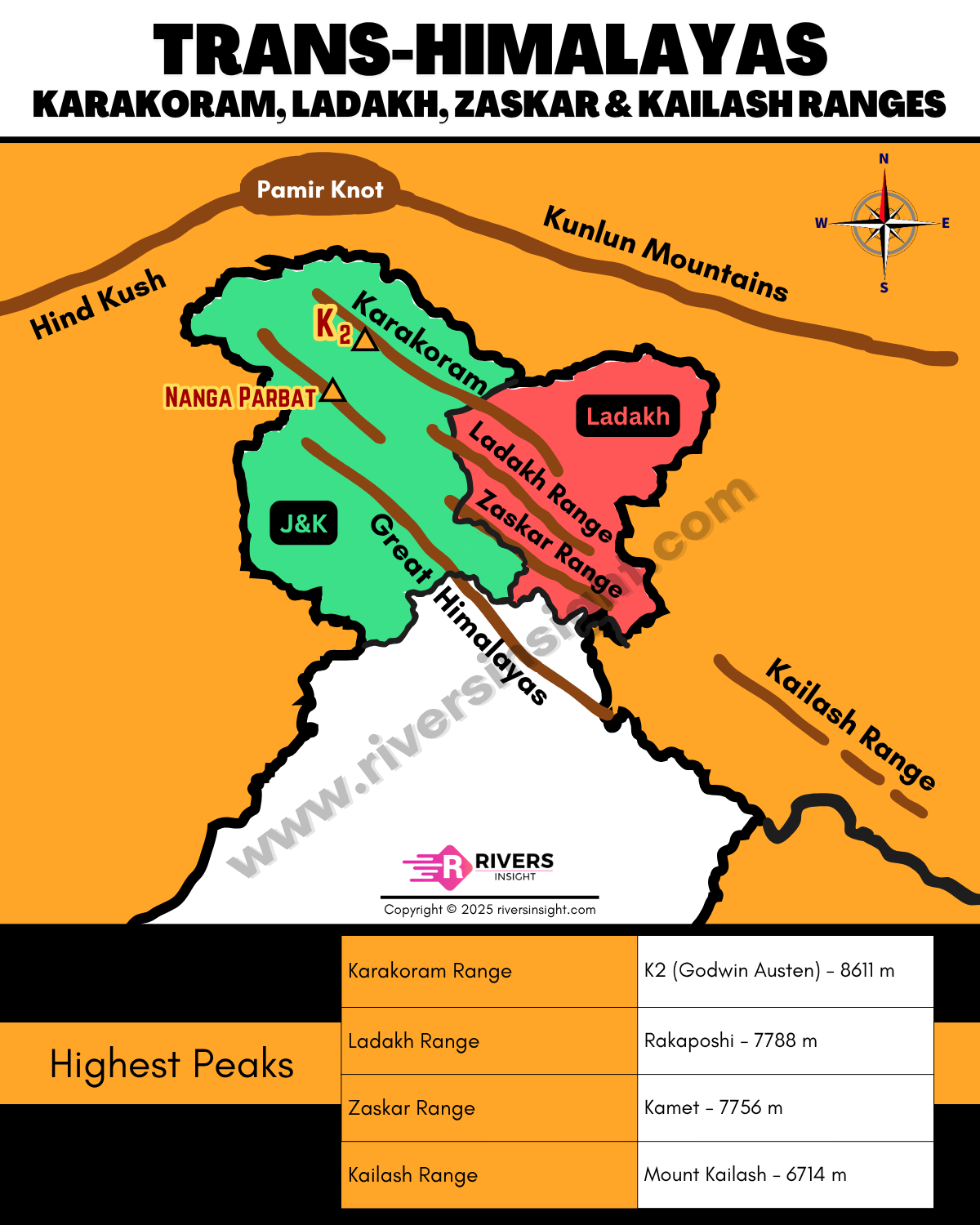
Trans-Himalayas, also called the Tibetan Himalayas, lie north of the Great Himalayan Range. Most of their expanse falls in Tibet, so this zone is also known as the Tibet Himalayan Region. It includes four main mountain ranges: Karakoram, Ladakh, Zaskar (Zanskar) and Kailash – stretching almost 1,000 km from west to east.
Quick Facts of Trans-Himalayas:
- Average height: around 3,000 m
- Width: 40 km (edges) to 225 km (centre)
- Climate: cold, dry, and windy
- Importance: forms India’s northern frontier and river source zone
- 2nd highest peak of the world: K2 (Godwin Austen)
Table of Contents
1. Karakoram Range
Karakoram Range, also known as Krishnagiri, is the northernmost part of the Trans–Himalayas. It extends for about 800 km east of the Pamir Knot and acts as a watershed between India and Turkestan.
- Serves as India’s border with Afghanistan and China.
- Average breadth: 120–140 km.
- Home to world-famous peaks like K2 (Godwin Austen or Qogir, 8611 m) – the world’s 2nd highest mountain.
- Major glaciers: Siachen, Baltoro – sources of icy streams feeding the Indus system.
- Because of its vast glaciers and icy landscape, the Karakoram is also called the “Third Pole.”
Did You Know? The Siachen Glacier is often called the world’s highest battlefield, where Indian troops serve at heights above 5,400 m.
2. Ladakh Range
Running south of the Karakoram and north of the Zaskar, the Ladakh Range forms the central part of the Trans–Himalayas. It merges eastward with the Kailash Range in Tibet.
- Major passes – Khardung La and Digar La, north and east of Leh.
- Bounded by Tibet (east), Himachal Pradesh (south), Gilgit–Baltistan and Jammu–Kashmir (west).
- Drained by Indus, Shyok, Nubra, Hanle, and Suru–Dras rivers.
- Terrain shaped by glaciers and rivers; full of rocky plains and steep valleys.
- Towns like Leh and Kargil lie along the valleys.
- Ladakh’s climate is severe and dry. So, it is known as a “cold desert”.
3. Zaskar (Zanskar) Range
The Zaskar Range lies south of the Ladakh Range and separates Ladakh from the Kashmir Valley. It acts as a natural boundary between the Ladakh region and the Jammu–Kashmir plains. Moreover, it also divides Kinnaur and Spiti in Himachal Pradesh.
- Source region for rivers like Hanle, Khurana, Zanskar, Suru, and Shingo – all joining the Indus later.
- Famous for Kamet (7756 m), one of India’s tallest peaks.
- Contains Himachal’s highest peaks.
- Pass: Pensi La, linking Suru and Zanskar valleys.
During winters, the Zanskar River freezes completely, creating the adventurous Chadar Trek, where people walk over the ice.
4. Kailash Range
Kailash Range is also called Gangdise in Chinese, lies east of Ladakh in western Tibet. It is an extension of the Ladakh Range.
- Average height: 5,500–6,000 m
- Width: around 30 km
- Highest peak: Mount Kailash (6714 m) – sacred to Hindus, Buddhists, Jains, and Bon followers.
- Nearby lies Lake Manasarovar, one of the world’s highest freshwater lakes.
- Key ridges and points – Helmet Top, Gurung Hill, Spanggur Gap, Rezang La, Rechin La.
- Chushul Bowl: communication and defense area located under the Kailash Ridge.
Kailash region is not only a religious centre, but also the starting point of major Asian rivers — the Indus, Sutlej, Brahmaputra, and Karnali all rise from this sacred plateau.
| Range | Highest Peak | Height (m) |
|---|---|---|
| Karakoram | K2 (Godwin Austen) | 8611 |
| Ladakh | Rakaposhi | ~7788 |
| Zaskar (Zanskar) | Kamet | 7756 |
| Kailash | Mount Kailash | 6714 |
Rivers from the Trans–Himalayas
Trans–Himalayas may look dry, yet they give birth to some major rivers.
- Indus River rises near Mount Kailash, collecting waters from Zanskar, Shyok, Nubra, and Suru.
- Sutlej also begins close to Lake Rakshastal near Kailash.
- From the Karakoram, glaciers feed the Shyok and Nubra rivers.
- The Zanskar Range gives rise to the Zanskar and Suru rivers.
Almost every stream here finally joins the Indus system, turning cold deserts into living valleys.
Significance of the Trans–Himalayas
- Acts as a natural frontier between India and Central Asia.
- Holds strategic importance due to high passes and glaciers.
- Source of many great rivers like Indus, Sutlej, Brahmaputra, and Karnali.
- Rich in minerals and glacial water reserves.
- Carries deep religious and cultural connections, especially around Mount Kailash.
- Despite its harsh, desert-like conditions, it represents human endurance and adaptation in extreme environments.