Patkai, Naga and Manipur Hills: Map, Location & Key Features
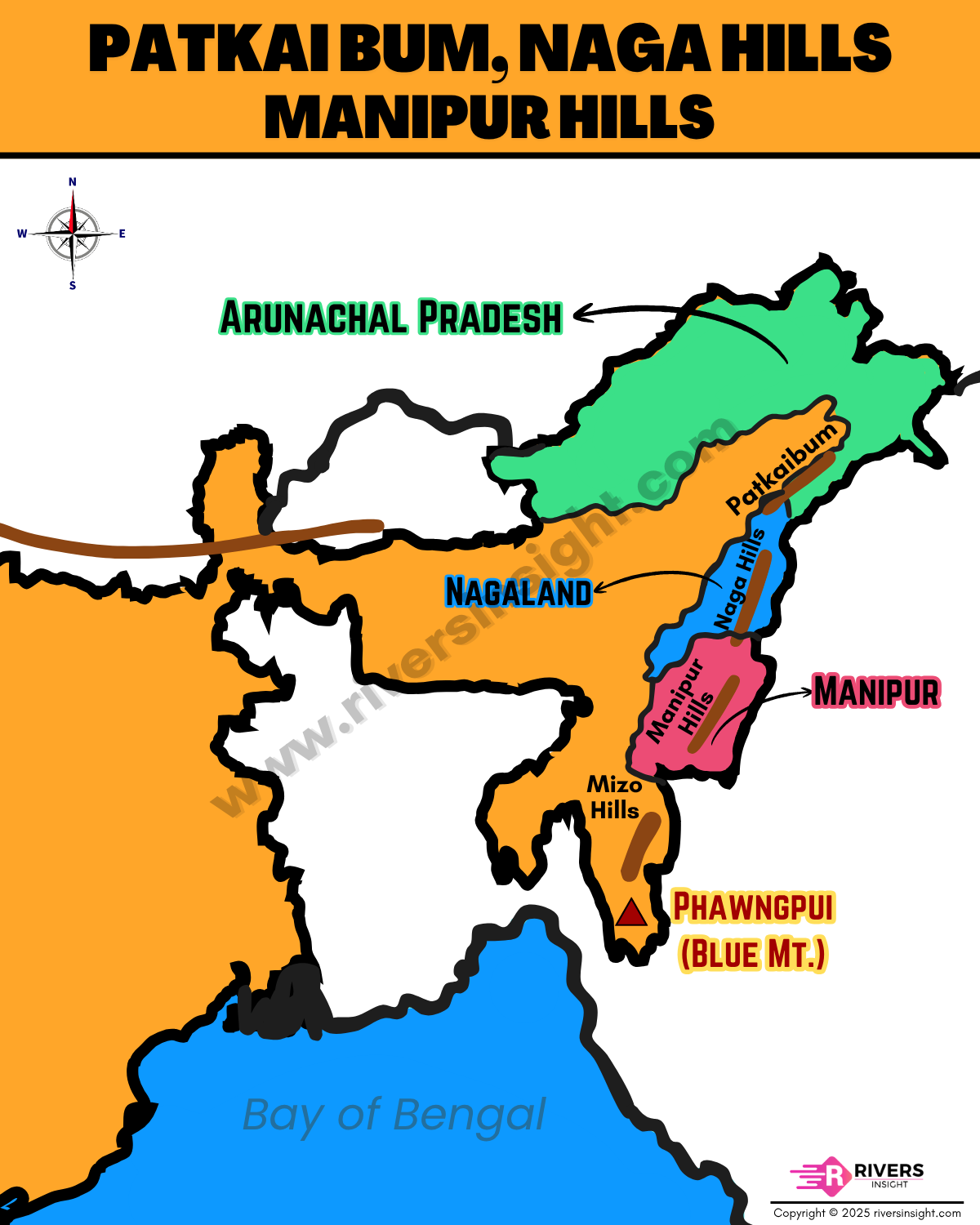
Patkai, Naga, and Manipur Hills form the easternmost extension of the Purvanchal Hills, stretching along the Indo–Myanmar border through the states of Arunachal Pradesh, Nagaland, and Manipur.
Advertisements
These ranges act as a natural frontier between India and Myanmar, connecting the Himalayan system in the north with the Arakan Yoma mountains in the south.
Table of Contents
Major Hill Ranges of the Frontier Highlands
1. Patkai Hills (Patkai Bum)
- The Patkai Hills, also called Patkai Bum, form the northernmost range of the Purvanchal Hills, located along the Indo-Myanmar border.
- They stretch across Arunachal Pradesh, Nagaland, and northern Myanmar.
- These hills were formed by the same tectonic forces that uplifted the Himalayas, but they are lower and less rugged.
- The region features conical peaks, steep slopes, and deep valleys with heavy forest cover.
- Dapha Bum (4,500 m) is the highest peak in this range.
- They act as a transition zone between the Eastern Himalayas and Southeast Asian hill systems.
- Important passes like Pangsau Pass connect India with Myanmar.
- Several small rivers, including tributaries of the Noa-Dihing and Tirap Rivers, originate here and drain into the Brahmaputra Basin.
2. Naga Hills
- The Naga Hills lie to the south of the Patkai Hills and form the central section of the Indo-Myanmar hill system.
- They extend across Nagaland and the northern parts of Manipur, with their eastern slopes merging into Myanmar.
- Mount Saramati (3,826 m), located on the India–Myanmar border, is the highest peak in the Naga Hills.
- The hills are home to the Naga tribes, known for their unique traditions and terraced agriculture.
- Rivers like the Dhansiri, Doyang, and Dikhu originate from these hills and flow northward toward the Brahmaputra Valley.
- The Naga Hills serve as an important ecological corridor between India and Southeast Asia.
3. Manipur Hills
- The Manipur Hills lie south of the Naga Hills and surround the Imphal Valley on three sides — north, east, and south.
- They form the southernmost extension of the Purvanchal Range before merging into the Mizo Hills.
- Average elevation varies between 900 to 2,700 metres.
- The hills are heavily forested and intersected by narrow valleys and rivers.
- Major rivers such as the Barak River and its tributaries originate from these hills.
- Loktak Lake, the largest freshwater lake in Northeast India, lies in the adjoining valley region.