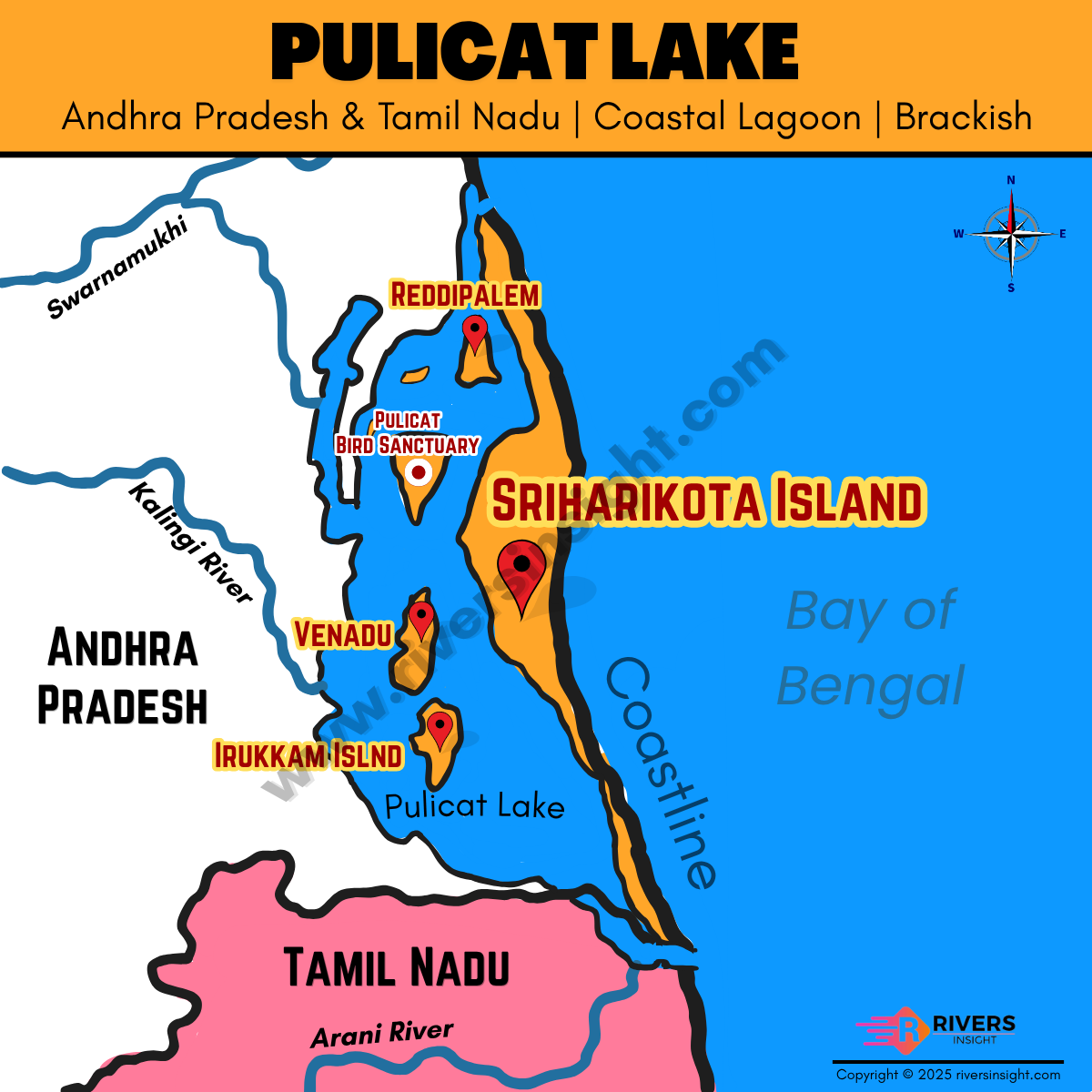
Pulicat Lake | 2nd Largest Brackish Water Lagoon
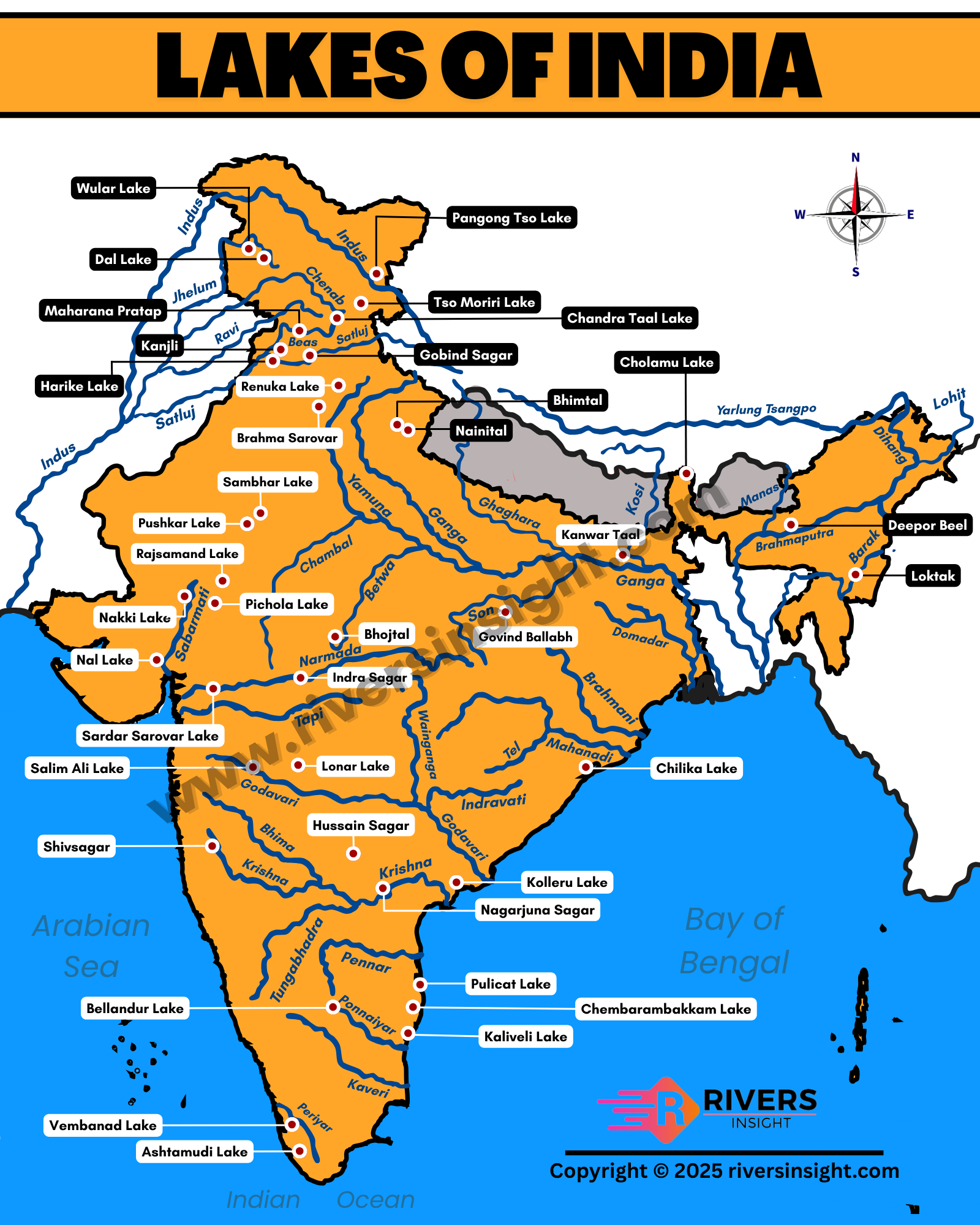
Pulicat Lake is the second-largest brackish water lagoon in India after Chilika Lake, located along the Coromandel Coast on the eastern side of India. It stretches across the states of Andhra Pradesh and Tamil Nadu, lying just north of Chennai, and can be easily identified on the lakes map of India in the southeastern coastal region.
Table of Contents
Physical Features of Pulicat Lake
Location & Regional Distribution
Pulicat Lake spans two states, but its distribution is uneven:
- About 84–96% of the lake lies in Andhra Pradesh (mainly in Tirupati and Nellore districts)
- The remaining portion lies in the Tiruvallur district of Tamil Nadu, near Pulicat town
The lake extends for around 60 km in length, with a total area of approximately 759 sq km, though this varies with seasonal changes.
It is separated from the Bay of Bengal by Sriharikota Island, a long sandy barrier that maintains the lagoon system. This island is also home to ISRO’s Satish Dhawan Space Centre, adding strategic importance to the region.
The surrounding region forms part of the coastal plains influenced by the Eastern Ghats, which shape the drainage pattern of rivers flowing into the lake.
Hydrology and River Connections
Pulicat Lake is sustained by a combination of freshwater inflow and tidal seawater exchange.
The major rivers feeding the lake include:
- Swarnamukhi River
- Kalangi River
- Arani River
These rivers bring freshwater, while seawater enters through narrow inlets, creating a brackish water environment. The balance between these inputs determines salinity, sediment flow, and overall ecosystem health.
To read more about the rivers near Pulicat Lake, you can read this article – Rivers of Andhra Pradesh
Formation and Lagoon Dynamics
Pulicat Lake developed as a coastal lagoon due to longshore sediment deposition along the Coromandel Coast. Over time, sand barriers formed, isolating a portion of seawater and creating a semi-enclosed water body.
This results in:
- Seasonal fluctuation in water spread (around 450–759 sq km)
- Changing salinity gradients
- High ecological productivity
This formation process is comparable to other Indian lagoons like Vembanad Lake, though Pulicat is more sensitive to coastal and monsoonal variations.
Pulicat Bird Sanctuary
A significant part of Pulicat Lake is protected as the Pulicat Lake Bird Sanctuary, which spans across both Tamil Nadu and Andhra Pradesh. The Tamil Nadu portion was first notified in 1980 and later declared a sanctuary in 1990.
The sanctuary is managed by the forest departments of the respective states and plays a crucial role in protecting migratory birds such as flamingos, pelicans, herons, and egrets. The shallow, nutrient-rich waters of the lake provide an ideal feeding and breeding ground for these species.
The lake region is also classified under Coastal Regulation Zone (CRZ-I), which indicates its high ecological sensitivity and restricts certain types of development. However, some areas within the lake still face management challenges due to unclear ownership and human pressure.
It supports:
- Large populations of flamingos (seasonal highlight)
- Pelicans, herons, egrets, and other water birds
- Fish, prawns, and other aquatic species
Flamingo Festival
Flamingo Festival is celebrated annually around Pulicat Lake to mark the arrival of migratory flamingos during the winter season. Organized mainly in the Andhra Pradesh region, the festival highlights the ecological importance of the lake as a major bird habitat.
During this period, large flocks of flamingos and other migratory birds gather in the shallow waters of the lagoon, attracting bird watchers, researchers, and tourists. The event also promotes eco-tourism and wetland conservation awareness.