Bhagirathi River: Origin, Map, Tributaries & Confluence
Bhagirathi River is a significant tributary of the Ganges River in India, originating from the Himalayas and flowing through Uttarakhand. It is located in northern India, although its course can be traced on the India map, flowing through the districts of Uttarkashi, Tehri, Garhwal, and Rishikesh. Moreover, the Bhagirathi River is a Himalayan river classified as a perennial river, meaning it flows throughout the year.
Key Facts of Bhagirathi River
| Origin: | Gaumukh (Gangotri Glacier), Uttarakhand |
| Length: | ~205 km |
| State: | Uttarakhand |
| River System: | Ganga River System |
| Confluence: | Devprayag |
| Type: | Perennial Himalayan River |
| Basin Area: | 6,920 square kilometers |
Table of Contents
Origin and Starting Point of Bhagirathi River
Bhagirathi River originates from the Gaumukh Glacier located at the base of the Khatling and Gangotri Glaciers in the Garhwal Himalaya.
The melting ice from the glacier gives rise to the river, making it one of the most important sources of the Ganga River.
Course and Route of Bhagirathi River
After its origin, the river flows through:
- Uttarkashi
- Tehri Garhwal
- Mountain valleys, steep gorges, and rocky terrain
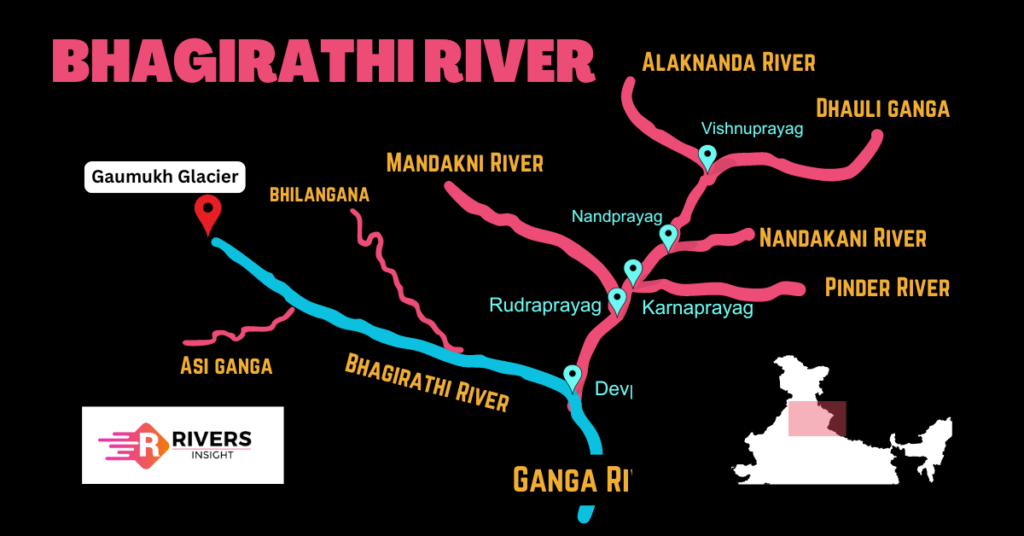
It finally meets the Alaknanda River at Devprayag, where both rivers combine to form the Ganga River.
Bhagirathi and Alaknanda Confluence (Devprayag)
At Devprayag, the Bhagirathi River merges with the Alaknanda River.
- Before confluence → River is called Bhagirathi
- After confluence → River becomes Ganga
This site is part of the Panch Prayag and holds great religious importance.
Map of Bhagirathi River
The map below shows the origin, course, tributaries, and confluence of the Bhagirathi River.
Tributaries of Bhagirathi River
- Bhilangna River (largest tributary)
- Jadh Ganga River
- Kedar Ganga River
- Asi Ganga River
- Solani River
Dams
Here is the list of dams on the Bhagirathi River:
- Tehri Dam (one of the largest dams in India)
- Maneri Dam
- Koteshwar Dam
Important Note: Bhagirathi vs Hooghly (West Bengal)
Bhagirathi River in Uttarakhand should not be confused with the Bhagirathi-Hooghly River in West Bengal, which is a distributary of the Ganga.
Significance
The place is considered holy to Hindus as it is the birthplace of Ganga. The Char Dham temple of Gangotri is situated on the banks of the Bhagirathi River. The Bhagirathi River is part of the sacred Panch Prayag Yatra, which includes 5 holy confluences in Uttarakhand: Devprayag, Rudraprayag, Nandprayag, Karnaprayag, and Vishnuprayag.
The Sangam of Bhagirathi and Alaknanda is a significant place of pilgrimage, and taking a dip here is believed to grant moksha. There is an ancient temple here, which is an important place of worship. The colors of the Bhagirathi and Alaknanda rivers are distinct and can be seen separately.
Dashrath Shila temple dates back to the time of Ramayana and is associated with Raja Dashrath and Lord Ram. Dashrathachal is a small hill known as Dashrath’s throne. Raghunath Temple is dedicated to Lord Ram and has idols of Sita Maa and Laxman, with a unique blend of Buddhist and South Indian architecture. The temple was redeveloped by Maharaja Gulab Singh in 1839.