Sambhar Lake | India’s Largest Inland Salt Lake
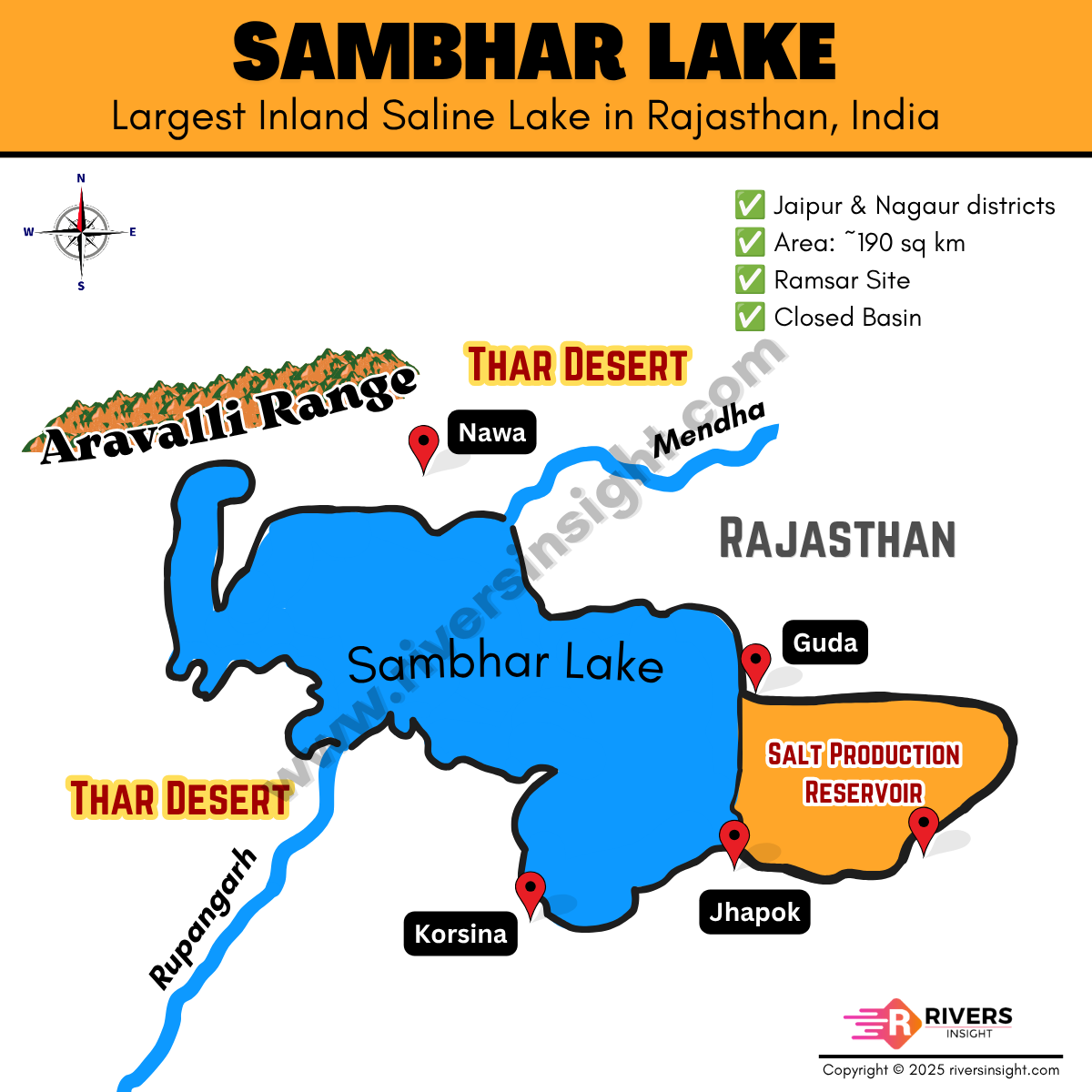
Sambhar Lake is the largest inland saline lake in India, located in Rajasthan across Jaipur, Nagaur, and Ajmer districts. Spread over roughly 190 sq. km, it represents a rare playa-type wetland system in an arid landscape. Additionally, it was designated as a Ramsar Site in 1990, recognizing its importance as a wetland of international significance under the Ramsar Convention.
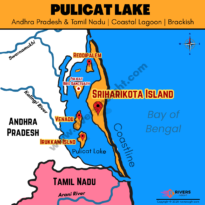
Unlike freshwater lakes such as Wular Lake or coastal lagoons like Pulicat Lake, Sambhar is an endorheic saline basin, where water accumulates but does not drain out, leading to high salt concentration through evaporation.
Table of Contents
Sambhar Lake – Key Facts
| Feature | Details |
|---|---|
| Name | Sambhar Lake |
| Location | Jaipur & Nagaur districts, Rajasthan |
| Type | Inland saline (endorheic) lake |
| Area | ~190 sq. km (varies seasonally) |
| Basin Type | Closed basin (no outlet) |
| Major Inflow Rivers | Mendha, Rupangarh, Khari, Khandela |
| Ramsar Status | Yes (Designated in 1990) |
| Catchment Area | ~5700 sq. km |
| Religious Site | Shakambhari Mata Temple |
Location of Sambhar Lake
Sambhar Lake lies near the eastern margin of the Thar Desert and is surrounded by low hills of the Aravalli Range.
Key geographical features:
- Basin length ~22.5 km, width 3–11 km
- Average depth extremely shallow (~0.16 m)
- Almost flat lakebed with minimal slope
The lake is divided by a man-made embankment (1924) into:
- Western part → relatively natural
- Eastern part → heavily modified for salt extraction
Hydrology & Seasonal Nature
Sambhar Lake is an ephemeral lake, meaning:
- It fills during monsoon (Aug–March)
- Often dries out in summer
It is fed by seasonal rivers such as:
- Mendha River
- Rupangarh River
- Khari River
- Khandela River
Bird Diversity and Avifaunal Richness
Long-term studies (1990–2009) recorded:
👉 83 species of waterfowl in the lake and surrounding wetlands
Key Bird Groups
- Waterfowl
- Pintail, Shoveller, Teal, Pochard
- Grebes and geese
- Waders and Shorebirds
- Sandpipers, Redshanks, Godwits
- Avocets and plovers
- Raptors
- Marsh Harrier, Steppe Eagle
- Peregrine Falcon
- Colonial Waterbirds
- Egrets, herons, cormorants
Flamingo Dynamics (Scientific Insight)
Sambhar Lake is famous for Greater and Lesser Flamingos, but the study reveals deeper facts:
- Lesser Flamingo is the dominant species
- Populations can exceed 20,000 birds in peak conditions
- Arrival depends on rainfall and water availability
However, scientific observations indicate that flamingos have not successfully bred in Sambhar Lake, despite occasional nesting attempts.
Salt Production System
Sambhar Lake is India’s most important inland salt-producing lake, supported by a well-developed salt extraction system. The lake is divided by a 5.1 km dam, with the eastern section used for salt production.
This area contains centuries-old salt pans, fed by saline water from a large catchment (~5700 sq. km) through rivers like Mendha and Rupangarh. Due to the lake’s closed basin and high evaporation, salts continuously accumulate, making large-scale production possible.
A Salt Museum in the region documents traditional extraction techniques, while British-era railway infrastructure reflects the long-standing commercial importance of the lake.
Official Source: indianbirds.in