Vembanad Lake | Map, Location (Kerala)
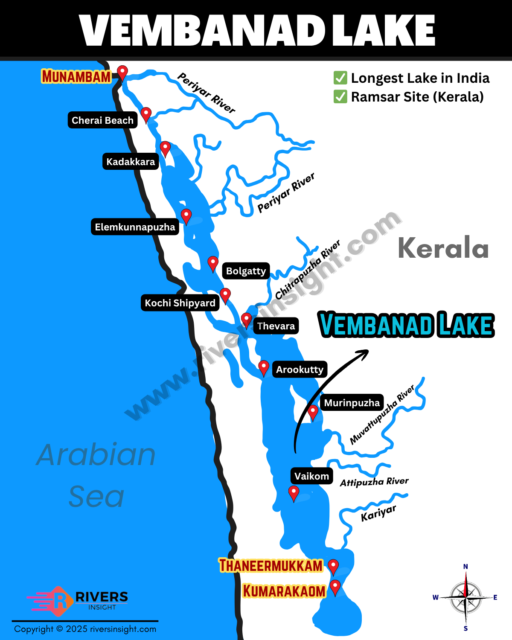
Vembanad Lake is the longest lake in India and one of the most important water bodies in Kerala. It is located along the Malabar Coast and can be easily identified on the map of Indian Lakes in the southwestern region. Unlike many inland lakes, Vembanad is a brackish water lagoon, influenced by both rivers and the Arabian Sea.
Further, it is also known by different local names, such as Punnamada Lake in Kuttanad and Kochi Lake in Kochi.
Table of Contents
Location, Rivers & Physical Features
Vembanad Lake extends across three major districts of Kerala: Kottayam, Alappuzha, and Ernakulam. The region is part of the coastal plains influenced by the Western Ghats.
As you can see in the map of Vembanad Lake, it is fed by several rivers, including:
- Periyar River
- Pamba River
- Meenachil River
- Muvattupuzha River
- Achankovil River
Additionally, it stretches for about 96 km, and the total wetland area is around 2033 sq km, making it one of the largest wetland systems in India.
Islands & Surroundings
The lake contains several islands, including:
- Vypin Island
- Willingdon Island
- Pathiramanal Island
- Mulavukad
- Vallarpadam
Unique Features
Vembanad Lake is the central part of the Kerala Backwaters, a network of lagoons, canals, and lakes running parallel to the Arabian Sea.
One of its most unique features is the Thanneermukkom Bund, a barrier built across the lake:
- Controls saltwater intrusion
- Helps in agriculture (especially paddy fields)
The lake is also famous for the Vallam Kali (Nehru Trophy Boat Race), a traditional snake boat race held every year in August.
The area of this lake includes the Kumarakom Bird Sanctuary, which attracts migratory birds and has been identified as an Important Bird Area (IBA).
Ramsar Status & Conservation
Vembanad Lake was designated as a Ramsar Wetland Site in 2002, recognizing its international importance. It is also the second-largest Ramsar site in India after the Sundarbans.
For more details, refer to the Ramsar Convention website.
The wetland is:
- Included under the National Wetlands Conservation Programme
- Recognized for its ecological and economic importance
For more details, you can visit the official source of Indian Biodiversity Wetland Conservation.